Tribal Engagement Teams

Last week in our first excerpt from Special Forces Major Jim Gant’s paper, “One Tribe At A Time,” Maj. Gant laid out the concept for a specialized type of American unit–a Tribal Engagement Team. Such teams would be small, highly trained and motivated, and granted broad latitude in the means of pursuing their mission. They would live full-time in the villages with the tribes, “lead, assist, train, supply,” and help organize Tribal Security Forces (TSFs.)
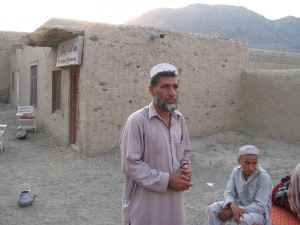
Dr. Akhbar was the first person ODA 316 met in Mangwel village
Will this work? How does Maj. Gant know? This week I’d like to examine the real-life basis for the Tribal Engagement Team idea, from Maj. Gant’s experience. Here he describes his team’s arrival in Afghanistan:
ODA 316 [Maj. Gant’s 12-man Special Forces “A” team] deployed to Asadabad in Konar province in April of 2003. The mission was broad, “kill and capture anti-coalition members.” We needed to immediately get a feel for the area and everything that entails. I came up with a plan to conduct multiple Armed Reconnaissance patrols to gather information and meet with as many village elders as possible.
In the village of Mangwel, ODA 316 encountered and befriended a tribal chief, Malik Noorafzhal, who was then at the brink of an armed conflict with other tribal elements who were affililated with HIG, Hezb-e Islami, the party loyal to the warlord Gulbuddin Hekmatyar.
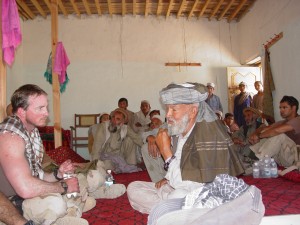
First meeting between Maj. Gant and Malik Noorafzhal
It is hard on paper to explain the seriousness of the situation and the complexity of what we both were facing. [Malik Noorafzhal] had asked for help, a thing that he later would tell me was hard for him to do (especially from an outsider) and I had many options. Could I afford to get involved in some internal tribal warfare? What were the consequences if I did? With the tribe? With the other tribes in the area? With my own chain of command? The decision I made was to support him. “Malik, I am with you.”
To make a long story very short, the dispute was resolved in Noorafzhal’s favor after it became clear that the Americans were on his side. Stability was restored. A bond had been established between the tribe and ODA 316. Not long after, the Malik invited the team to spend the night in his village, pledging that he would protect them.
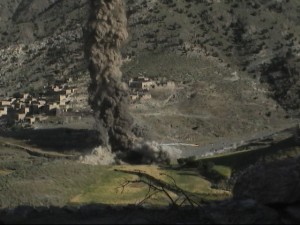
The dispute was resolved in the tribe's favor
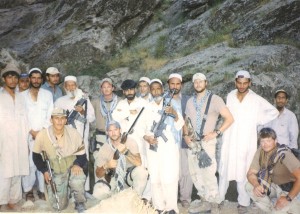
… we moved to Malik Noorafzhal’s compound. I immediately was able to count over sixty [tribal] warriors, all armed, in the area. There were sentries high in the mountains (on the Pakistani side) that we were not meant to see and at least three layers of security near his compound. The Malik then approached me and told me he wanted to take me somewhere very special. I, of course, agreed. I grabbed three of my men, gave a quick contingency plan to the rest of the team, and got in several pickup trucks with Malik Noorafzhal and his men. We began traveling up towards the beautiful mountain range behind Mangwel (with just weapons, no body armor) towards Pakistan. We drove up a valley and began passing an Afghan cemetery with the large flat rocks emplaced into the ground. There were many graves. Off in the distance there was what appeared to be an old village that had been destroyed. The vehicles parked and we all got out. Malik Noorafzhal grabbed my hand and we walked hand in hand up a small valley into the mountains. We turned a small bend and there was a beautiful waterfall. He told us to drink the water. He then came next to me and said, through my interpreter, “Jim, the last time I saw a person with a face like yours (meaning white), the Russians killed 86 of the men, women and children of my village.” He continued, “This is my old village. We fought the Russians. They never took my village. We are ready to fight again if we have to.” He looked and finished with, “You have great warriors with you. We will fight together.” We then just stood there for a few minutes and looked back into the valley, where you could see the old village and the new one. It was an incredible moment that cannot be put into any metrics or computer program that says “success” today. But it was. The bond continued to grow.
Just before going up to Old Mangwel. Fifth from the left is Malik Noorafzhal, holding Maj. Gant's M-4. The other Americans are SFC Travis Weitzel, standing; SFC Mark Read, kneeling on the left, and SFC Scott Gross on the right.
A unique aspect of Special Forces training is that it stresses “people skills.” One of the missions that SF teams train for is insertion into remote areas with the aim of establishing rapport with the local “G-chiefs”–guerrilla leaders–and indigenous elements. This means face-to-face, person-to-person.
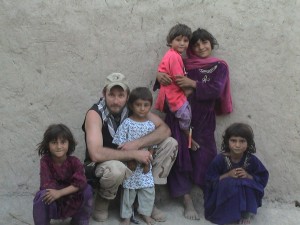
I want to interject a couple of situations that might also tell of the relationship that was built with Malik Noorafzhal and my team. He and Dr. Akbhar were very open with their homes and families. I spent countless hours playing with Dr. Akhbar’s small children and the Malik’s grandchildren. The Malik used to say to me, “Jim, I am getting too old, play with the children today, they love you.” So do you know what my primary task would be for the day? I would play with the children–for hours. They would teach me Pashtu and I would teach them English. We would be watched by literally hundreds of younger children and women as we played. I often thought that these ‘play sessions’ did more for our cause in the Konar than all the raids we did combined.
Another point here is that my men developed their own very personal relationships with the people. Each one had his own “following” of people that included other elders and other children. When we would drive up to the village, different sets of people would run up to different members of the team calling them by name.
Their families were our families
One of the most critical and underappreciated aspects of fighting an insurgent enemy is the acquisition of actionable intelligence.
Then the Malik told my interpreter he needed to speak with me alone, outside. He then handed me a list with five names on it. He said these men were “bad and against the government and U.S. forces.” I had my interpreter read the names to me and knew that at least two of them were local members of Hezb-e Islami. Then the highlight of my military career took place. The Malik took my hand, looked me in the eyes and said through my interpreter, “Commander Jim, I have 800 warriors and they are at your disposal. You only need to ask and they will be yours…”
As our relationship grew, there many other stories and examples that I could give the reader to make my point, but I will only give a few more examples. One particular trip, Malik Noorafzhal said he had a “problem” he wanted to discuss. He said “people” (between the lines it was personnel from HIG) had come down in the village and accused him of allying with the Americans and that he and his village were becoming “Christians” and that Allah was going to make them pay for their actions. We spoke about the topic for quite a while. The bottom line was that I told him,” We should kill them.” While all of this was going on, we were getting an incredible amount of actionable intelligence from Malik Noorafzhal’s “kasheeka.” We received a lot of information from locals at our firebase on a daily basis, but most of it was worthless. The intelligence we got from Malik Noorafzhal and his men was correct–100 percent of the time.
Maj. Gant acknowledges one mistake that has powerfully influenced his conception of future Tribal Engagement Teams–the fact that he and ODA 316 did not have the resources to maintain a 24-hour presence in the village of Mangwel to help provide security for the tribe.
It became very apparent that the relationship we had built with the tribe was causing them to become a target for HIG in the area. We could not stay in the village 24 hours a day due to our other mission requirements and in retrospect and many more years of experience under my belt, not moving to Mangwel was a mistake. Since we could not maintain a 24 hour presence in the village (which they had asked for on two separate occasions), I decided to give them as many weapons and as much ammo as I could get my hands on. I felt like not only was it the right and best thing to do, but the moral thing to do as well. I had asked them to risk so much–what else was I supposed to do? I am very comfortable with the decision for two reasons. First, they needed more weapons to help defend themselves and more importantly Malik Noorafzhal and his people viewed us giving them weapons as gifts. These gifts bound us together even more than we already were. Power in this area was about the ability to put armed men on the ground to attack an adversary or defend their tribe. Guns were the ultimate currency.
The Tribal Engagement Teams proposed in Maj. Gant’s paper would arm the Tribal Security Teams and finance them, as well as living with them, training, assisting and leading. Could such a Tribal Engagement strategy work today in Afghanistan?
The key to this strategy is going to be the ability to identify men (Tribal Engagement Teams) who have a special gift for understanding cross-cultural competency and building rapport. These men will have to like to fight and spend countless months, even years, living in very harsh circumstances. They will have to truly understand concepts like honor, loyalty and revenge. Initially, they will have very little physical security other than the AK-47 they carry, their planning skills and the tribal fighters they live with.
My true belief is that a relatively small number of special officers and non-commissioned officers could maintain influence within large portions of Afghanistan by advising, assisting, training and leading local tribal security forces– ‘arkabais’–and building true relationships with the tribes they live alongside.
The tribes are not the enemy. The ‘insurgents’ are the enemy. Al-Qaeda, the Taliban, HIG (Hezb-e Islami) and the Haqqani networks and several other enemy elements are the enemy. The tribes and their systems are not the enemy. Most of the Taliban are Pashtuns. However, all of them are from tribes. Doesn’t it make sense to make friends with as many of them as we can, while at the same time learning about our enemies? In truly engaging the tribes and understanding tribalism at its core, we will also be able to link and understand the problems in both Afghanistan and Pakistan.
[In Part 3, next week, Maj. Gant’s paper will get into the “how” of Tribal Engagement. Meanwhile this blog’s crack design staff–former Army captain Printer Bowler of Missoula, MT–is busting his butt preparing a free, downloadable .pdf of the entire document. We’ll post it in this space as soon as we’ve got it.
[Questions for Maj. Gant? Type them into the Comments boxes. Maj. Gant is currently at Fort Bliss, TX, preparing to deploy to Iraq.]
DO THE WORK
Steve shows you the predictable Resistance points that every writer hits in a work-in-progress and then shows you how to deal with each one of these sticking points. This book shows you how to keep going with your work.


THE AUTHENTIC SWING
A short book about the writing of a first novel: for Steve, The Legend of Bagger Vance. Having failed with three earlier attempts at novels, here's how Steve finally succeeded.

NOBODY WANTS TO READ YOUR SH*T
Steve shares his "lessons learned" from the trenches of the five different writing careers—advertising, screenwriting, fiction, nonfiction, and self-help. This is tradecraft. An MFA in Writing in 197 pages.

TURNING PRO
Amateurs have amateur habits. Pros have pro habits. When we turn pro, we give up the comfortable life but we find our power. Steve answers the question, "How do we overcome Resistance?"

This installment really hits the point. We must develop these close relationships with the tribes in Afghanistan. The difficulty will be in finding enough people with the personality of MAJ Gant and his men to be able to do this successfully. We have arguably the best military on the planet; however, our people are still subject to the frailties of bigotry and hatred toward people who are not like them. We are doing better than in the past in this area, but hatred still persists. To accomplish this type of mission, we’ll need to seek tough people who are also capable of learning about, and even embracing, other cultures. We will need people who are willing and able to “go native” and live among these tribes.
While it is encouraging to read insightful and lucid commentray into tribal relations it should not obscure the mindless, shortsighted and politiclly motivated energy and foreign policies that has made understanding tribes, for whom the 7th century is the optimal template for oranizing human activity and relationships, so vital to the national interest.
A profound and powerful post, Major Gant.
Thank you for your service and your insight.
Questions for MAJ. Gant…
1. Your position and proposal seem to make sense to probably most of the readers here. Why wouldn’t the decision makers like your ideas?
2. The type of mission you propose appears to be classic SF (maybe not seen since the Vietnam era) do you think this will have a negative or positive impact towards your ideas being accepted and implemented?
Finally, thank you. I know what you do takes more than being able to get a 280 or higher on a APFT. I stand in awe and appreciation for what you and your brethren do for this country.
Wisner,
Thank you for reading the blog and asking a few questions. First, I want to make it very clear that I am a “tactical” guy. I have never commanded an SF company, of any kind. The complexity of the situation in Afghanistan is almost undescribable. Many men, much smarter and with more experience in the Army than I have; have to make life and death decisions every single day. They are in charge of companies, battalions, brigades, etc…I cannot even begin to speak for any of them, becuase I have not been in their shoes. I also know that we (the leadership in the military) always try and do the right thing. Whatever that is. We accomplish missions – thats what we do. All this paper was, was me trying to wrap my head around the problem at the tactical level so that I could be successful when I returned to Afghanistan on a Transition Team. As I was working through it, I realized, based on my own personal experience, that my time in Afghanistan was most successful when my team and I engaged a tribe. I spent a lot of time speaking with Steve Pressfield about the subject and just started to write down what I had done and how I would do it again. While doing that, it occured to me that if the same thing that my team and I did was done on a larger scale, that it would have operational and strategic implications. So, in aswering your first question it isn’t that the “decision makers” don’t want to do this, it is a lot of different factors. Troop to task ratios, the risk, the 2nd and 3rd order effects of doing it, etc…It is a hard thing to just say, yeah go do this. With that being said, I believe it would work and that we could do it and that we would be successful doing it.
As for your second question – you are 100% correct. This is a classic SF mission and there are many good SF ODA’s out there that could do this very successfully. But once again, see above. The same problesm the Army would have doing this, SF runs into a lot of the same problems. SF has a lot on its plate right now.
Once again, thank you for writing and I hope I answered your questions. If not, please write back.
STRENGTH AND HONOR
Jim
MAJ. Gant (Jim),
Thank you for your response. I read somewhere that beginners talk about tactics and professionals talk about logistics…It would seem, from your professional insight, we maybe further from getting your proposals in place than I had hoped. I do have another question (I know you are busy so if you have time…). It looks like the XVIII Airborne Corps maybe moved to Afghanistan (have a HQ there anyway). Do you see this as possibly making a difference in the tribal engagement aspect or is this just a kinetic force? Again, thank you for your professional insight. Many of us do not get to interact with someone who has the insight and experience in the field so forgive the eagerness (at least on my part) to ask so many questions.
Maj. Gant,
1st off thanks for your service. Man what an incredible story..its reassuring to hear that the tip of the spear is sharp. Thanks to folks like you, common sense and the ablility to look beyond the obvious gives all of us back home a deeper understanding of the environment there and the efforts of our brave men and women in uniform. Im from El Paso.. hollar (email) if there is anything I might help you with. Vaya Con Dios Amigo.
Maj Gant,
Excellent read, very insightful. I look foward to your next peice. Unfotunately sir, I see a glaring problem that to my eyes is almost insurmountable. Even though in reality it doesnt seem like one.
“These men will have to like to fight and spend countless months, even years, living in very harsh circumstances. ”
Currently, our simple deployment schedule (built upon months rather than years) does not permit the type of long term planning and knowledge / rappor building required for an SF ODA to meet the requirement for your tribal engagement teams….. and if ODA’s are not conducting this type of operation, I can’t see any other body existing in the military doing it. I’m scared to see the type of organization the big A or even SF would create “quickly” for such a specific task, as I’ve seen other “adhoc” teams built to fix various problems…. aka MITTs, PITTs, etc. and I dont think that general caliber of soldier would fit the bill you described above.
If ODAs are meant to take on this task as a true long term tribal engager in AF or elsewhere, I think the current SF command and elsewhere needs to reorganize how the command staffs its ODAs. Officers given much more time on a detachment…. NCOs not forced off teams… deployments in years… rather than a few TOO short months…. Language learning increased….
But in the end, I don’t see any of these changes being made, I don’t think our leaders have guts or will to make these major changes to our force.
Please excuse a bit of the rant this has turned out…. again, great read sir, look foward to your next post.
18F – 5th SFG
Paul,
I hope all is well with you. Thanks for reading the blog and replying. You are correct, our current deployment schedule does not allow for this type of engagement to work. Rotating guys every six months will not allow us to have the impact that this type of mission is designed to do. I have also served on a Transition Team in Iraq in 06-07, so I have have experience on that side of the house as well. I realize the challenges that this TET strategy faces. It would take some drastic changes in how “we” (the military, the army, and SF) do business. One of the biggest problems is getting the right people to do this. When you start talking about people volunteering for a unit that spends a year downrange, a month at home, a year downrange, a month at home, for anywhere to three to five years – who is going to want to do that? Very few. I would love to do it. I know some other men who would as well. We have created all sorts of units in the last several years to meet all kinds of different challanges, why not create another one specifically for this? When the entire paper gets posted you will see that I address this. SF is by far the one military organization who at the current time is closest to being able to do this – but as I have said, SF has a lot on its plate right now. The personnel on these TETs couldn’t be just thrown into it. They would have to be very careful who they put on them. The TET members would have to have a deep commitment to Afghanistan and its people. I do have some thoughts on how SF could employ this to keep up the “continuity” that would have to be there for this to be successful. However, I am the first to acknowledge that I do not have the experience nor the background to fully understand the difficulties involved in employing entire SF Groups for long periods of time. There are large issues here, some of them that not only am I unaware of, but that I would not have the answers for. Finally, I know you have been to Afghanistan and I salute you. It is a harsh and dangerous place. Thank you for what you do for your country, the Army, and SF. Drop me an email sometime and let me know how you are doing.
STRENGTH AND HONOR
Jim
MAJ Gant,
You and your men are few and far between. Are there other men who could successfully implement your strategy? Yes. But they are few. I spent 22 years in the Army and have worked with and for SF for the last 5 years. The one thing you all have in common is that you are undoubtedly the best trained soldiers in the world. But the most important element that only a handful share (and I’ve met them) is passion. Passion for Special Forces, passion for what you do as a Green Beret and passion for other cultures. What you’ve done with Sitting Bull is miraculous. It’s as if Lawrence of Arabia himself led you to him. The fact that Sitting Bull would take you to visit the site of his old village, a white man with blonde hair and light eyes resembling the very Russians that destroyed it, is a testament to who you are as a person. You’ve shown on two fronts with two very different cultures that rapport, trust and a deep appreciation for other people are key to success. I read what you did in Iraq in 2006-2007. In your Silver Star ceremony (congratulations) you stated there were no Iraqis, no Americans, no Sunnis, no Shia, no Christians, no Blacks, no Whites. Just a group of men (paraphrasing). And it was evident that you loved the Iraqis you were with and that they loved you. This is extraordinary. You are extraordinary. You Sir, are our 21st century Lawrence of Arabia. My hope for you is that Gen McChrystal sees what you’ve done and summons you to Afghanistan to implement a proven strategy….one tribe at a time.
Erika,
Thank you for taking the time to read the stuff on the web-site and thank you for your kind words.
I will tell you this: No commander, of any time, in any army, was as blessed as I was to fight alongside the warriors that I had with me, in both Afghanistan and Iraq. My accomplishments in combat are a direct reflection of the men I fought for and the men I fought with.
It is easy to lead warriors into battle.
Thank you again for your kind words.
STRENGTH AND HONOR
Jim Gant
This is it!! The education being dispensed here needs to be spread to our leaders and law makers whom continually make the mistake of thinking that American society and values can be placed anywhere.
This war is entirely too public and should be fought the SF way using all of the instruments of US military might when needed. I am deployed and fly over watch for countless hours in Afghanistan. Our SF should be the primary fight and all assets should be given to them. Human intelligence is so vital to this war! Maj Gant Godspeed, wish I could be there living with you, for now I will have to settle for being a strike asset above waiting for your call.
Perhaps if you had a few teams who could swap out periodically this could work. For example, a few ODAs who are committed to a given tribe and work with them a year, hand off to another ODA who is dedicated to that tribe for 12 months then back to the the first ODA and so on. Even with personnel turnovers, you’d still have some overlap (thank God for NCOs and Warrants) to keep the correct “spirit” in the ODA (ie – keeping the feel from becoming bigoted or the like). I think it’s doable and you could avoid the 12 months on 1 month off, if done correctly.
S. Tabriz,
Thank you for taking the time to read the blog and all your comments as well. I agree that some sort of rotation like the one you mentioned above would be workable if you used an SF Group for the mission. SF is the organization that is the closest to being able to accomplish this type of mission right now. However, what I am envisioning is a small specialized unit (we have made ‘special’ units for many challenges since 9/11) that would have a deeper committment than a year on, on off, etc…this would work in an SF unit. I envision three to six guys that spend three years with the tribe with very little time at home, as I said, about a year in, and a month out. When you asked soldiers to do that – you won’t get very many volunteers. But that is the type of committment it would take. I would gladly do it in Mangwel, and I know a few other great men who want to go as well.
Thanks again for writing. I have enjoyed your insight.
STRENGTH AND HONOR
Jim
Sir,
I’m pretty sure your lecture on cross-cultural communication was the highlight of my school house experience. Having this paper published in serial is not only encouraging for those of us in the middle of the problem you speak of, but also for our families who are perpetually interested in the challenges we face as we attempt to bring a stable infrastructure to Afghanistan.
I have some questions pertaining to tribal relations in a more specific area, that I would love to have you field offline if you could just drop me a quick note with your e-mail.
I’m glad to hear you’re finally back in the fight.
Don’t Be Safe,
18C 20th Grp
Doug K,
Hope all is well. Sorry I did not get back to you sooner…been doing some Army training…
Thank you for your comments about the instruction out at Robin Sage. I put a lot of time and effort into being an instrcutor out there. I did what I did out there for guys like you.
Drop me a line at [email protected] and we will exchange emails and I will answer any questions that I can.
Be proud of who you are and what you do. Your country owes you a debt of gratitude.
STRENGTH AND HONOR
Jim
Jim,
What happens when two tribes with imbedded TETs have a beef that the imbedded TETs cannot mediate? Could we have U.S. army troops leading fights against one another? Or would there be a “We can’t fight our brothers” exception that must be understood?” I know that often, we point these tribes at the bad guys, but how often are the beefs between tribes not Al Qaeda or Taliban related?
Joe,
I just realized you asked both questions…sorry! This is a very important question. Here is what I think…First, the reason we first went to Mangwel was because of a “problem”. that “problem” was a fued withing the same tribe. Now this is where things get “sticky”…We very rarely operate in the “black” or the “white”…it is usually in the “grey”. I would venture to say the great teams spend almost all of their time there…so, I decided with very little actual information to tell Malik Noorafzhal that we would support him in whatever he wanted to do. Risky? I don’t know – but it was a good decision. Now to your question: Obviousely TETs would not “face off” against one another…now, as it is with security and protection, it is the relationship you have with the tribal leader that will decide what happens. Now, everything you have done since day one to build a true relationship with the tribal leader and his advisors come into play. Do you have enough “influence without authority” to keep this from happening? Can you influence the underlying issue/problem? Does the other TET have more influence than you? Can you make him see why we can’t do this? Can you and the other TET work “together” to find a mutually beneficial solution? Do you understand the culture enough, to include Pashtunwali, to use it to your advantage? Can you also determine when, in the worst case scenario , you know you can no longer influence the situation and the other TET is in danger? What do you do now? Have you planned for it? Do you stay? Does just one TET exfil? Do you both?
So! As you can see – I do not have the answer. I believe that “being there” with the right people can keep situations like this to a minimum. In closing, one of the most important pieces of information that a TET would need would be as much information as possible on the “human terrain” in the entire area. I would want to know prior to “infil” if possible, if a situation like this existed.
But I can assure you this…I would want other great team members with me to help me deal with a situation like this.
Thanks again!
STRENGTH AND HONOR
Jim Gant
Jim,
In order for this embed program to work, you would have to augment an ODA with soldiers who have the right skill set to effectively interact with the tribes. In addition to the 12 man team, you augment with another 12 to 24 soldiers who are attached to the ODA. Your team would have to then split, with 1/2 of the unit training or doing predeployment ops CONUS while the other half is down range. This would be the only way logistically you could swing it. The unit downrange would do regular SITREPS to their CONUS half of the team to read them in on the ever changing situation. Probably have to do a phased rotation to keep institutional memory and continuity. Logistically, it could be done. But we would have to get over some issues, like the augmentees. They would not be SF qualified but they would be learning SF type skills from the ODA members. To be accepted by the tribes, they would still have to be warriors, so we are looking at combat arms guys. The SF community would have to accept that. There could not be a rift between the “tabbed” SF guys and the augmentees. The tribe would notice it immediately. The only way you would get enough volunteers to do this type of mission is to give them regular rotations home to avoid battle fatigue. That means you have to grow the ODA but current limitations mean non SF soldiers would have to fill in the holes. Would your community embrace non SF soldiers doing SF type missions side by side with the ODA?
Joe Long
Joe Long,
Thank you very much for reading the blog and posting. You obviousely have some experience with this type of situation…
First, to me the most important question you ask is “would the SF community embrace non SF soldiers…side by side?” I can answer that with a definite “yes”. You would have to ask Travis Weitzal, Clay Petty, Luke Murray, Brent Watson, and Dave Casson. Ask them how they were treated on ODA 316. Yes, we ran some attachments off, but we ran some other SF guys off as well. It was tough to get into our (ODA 316) “tribe” (no pun intended). We didn’t give a damn about the tab. Are you a warrior or not? That is all that mattered to any of us. The guys mentioned above wore our team patch; we slept, ate, trained and fought TOGETHER. If you notice they are all mentioned in the back of the paper. They were given great responsibility. They went through all of our individual skills training and then were incorporated into all of our collective immediate action drills (IADs). The could shoot all the weapons, were very competent in combat trauma, could use all the radios, call for CAS and CASEVAC, etc. We are all still in touch today. Luke Murray lost his leg in IED strike about 25 miles north of Mangwel. They weren’t a part of the team…they owned as much of it as I did. But as I said, you would have to ask them.
Second, I like the “split” team concept where we would just “flip-flop” and while one group was in the box the other was resting, training, going to school, and reading the daily SITREPs.
Two things…I think the number of people you are talking about is too high. Me and one of my buddies (who I would want to take) have talked extensively about the correct number of guys for the TET. Of course, that would be situationally dependant, however, I believe it is three on the low end and six on the high end. That is one of the main reasons I believe this concept is so attractive. I believe we could do so much more with so much less (resources, soldiers and money) however, the TETs would have to be given that “special trust and confidence” to do what was needed. Also, if SF was going to take the lead on this, the issues on page six of the paper would need to be addressed – in a big way. Our normal method of operating would have to change, just like it would if we were asked to conduct a true UW mission in a semi-permissive environment.
So, I will quit rambling…
Thanks again and keep writing…I am taking notes. Really.
STRENGTH AND HONOR
Jim Gant
Jim,
Yeah, I used to live this stuff when I was an infantry officer about 20 years ago. Now I am a lawyer in Baton Rouge. Are you still at Ft. Polk? Have you ever heard of the Chindits? The British took infantry soldiers and turned them into guerrilla fighters to attack the Japanese rear in WWII. You also have the Montagnard model where SF embedded with an indigenous tribe to interdict the Ho Chi Minh trail in the Central Highlands during the Vietnam War. Maybe I could buy you a beer some weekend and we can talk about this proposal? BR is about three hours from Ft. Polk.
Let me know,
Joe Long
Attorney at law
247 Florida Street
Baton Rouge, LA 70801
(225) 343-7288
Sending you a DVD called “Operation Montagnard”. It chronicles the SF operation in the Central Highlands with the Montagnard tribe during the Vietnam war. Your concept has already been proven to work in a former U.S. conflict. This will lend more support to your proposal. Send me your mailing address.
Joe Long
Jim:
Wonderful paper. My concerns are twofold: That we’ll never have enough SF, never could have enough SF, to do the job (and if we tried we’d see quality drop through the floor), and that there’s still a requirement for more or less heavily armed regulars to keep the Taliban from massing enough to upset the apple cart (a nice euphemism for massacre our teams and their supporters / tribes).
If you’re interested, send me a snail mail to nrvlaw at aol dot com, and I’ll send you a couple of books that might be useful or, who knows, at a minimum entertaining.
best,
Tom Kratman
LTC, AUS (Retired)
tomkratman.com
[…] One Tribe At A Time #2: Tribal Engagement Teams […]
porn…
Afghanistan: Tribal Engagement Teams…