What I’ve Learned About Blogging So Far

In the coming weeks, I’ll start posting on regular days, probably Mondays and Thursdays (I’m working on it), probably a long piece and a short one. On other random days I’ll post “I take it back” pieces, highlighting how comments or correspondence have changed or expanded my thinking. I want to share what’s gotten knocked into my head; that’s the whole point of this enterprise. Meanwhile here’s what I’ve learned in three weeks:
Blogging is fast
Within two days of launching “It’s the Tribes, Stupid”, responses were zooming in. Two of the first and best were posted by Zenpundit and Fabius Maximus. They made it clear that we weren’t on the same page, but they also showed respect for the intent of the endeavor and they took the time to present well thought-out, balanced posts. I learned something from them—and I’ve continued reading their posts. The point to me is to stir the pot, not to congregate only with like-minded travelers.
Bloggers have sharp teeth
The blogosphere, I’m beginning to see, can also be the slogosphere. To you gentlemen (and you know who you are) who are snarling at each other on “It’s the Tribes,” please knock it off or take it outside. There’s no excuse for ad hominem snarkiness. Let’s keep the discourse on a plane our mothers would be proud of.
Blogging is hard work
When I started, I thought, “No problem, I’ll knock out five pieces a week and keep ‘em coming.” Not so fast, Steve. I discovered it’s as hard to write a good blogging post as it is to do any other form of serious writing. I respect it. It’s making me sweat!
There’s good stuff online
I didn’t realize how much interesting work lives online only. Through Small Wars Journal, I was introduced to Major Niel Smith. I quoted a paragraph from his article “Sisyphus and Counterinsurgency” in my June 30 post. Small Wars Journal also features the work of Patrick Devenny, though I was introduced to Patrick’s work through Twitter—just in time to catch his just-published Foreign Policy article titled “Call in the Cavalry: A historical look at how Afghanistan can be won—and lost.”
Views are easy, comments are hard
For every thousand views of a post, maybe two or three people leave comments. I’d love to figure a way to get that second number up. As I write this, according to Small Wars Council, 3,333 people have viewed a thread about “It’s the Tribes, Stupid” but only 32 have left comments. And these aren’t 32 different people. As Shakespeare wrote for King Lear: “Nothing will come of nothing: speak again.”
Blogging is fun
The videos and the entries posted thus far are just a beginning. For those who have remarked on what I’ve left out, there’s more to come. Continue pointing out what you think I’m missing and what you would enjoy reading more of in the future. Thanks!
DO THE WORK
Steve shows you the predictable Resistance points that every writer hits in a work-in-progress and then shows you how to deal with each one of these sticking points. This book shows you how to keep going with your work.


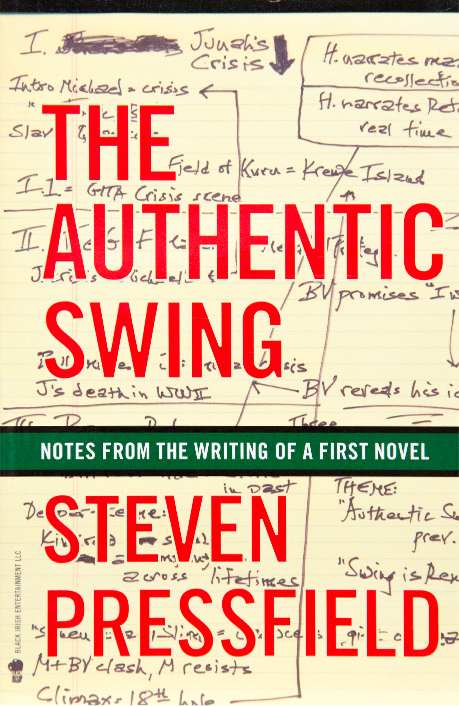
THE AUTHENTIC SWING
A short book about the writing of a first novel: for Steve, The Legend of Bagger Vance. Having failed with three earlier attempts at novels, here's how Steve finally succeeded.
NOBODY WANTS TO READ YOUR SH*T
Steve shares his "lessons learned" from the trenches of the five different writing careers—advertising, screenwriting, fiction, nonfiction, and self-help. This is tradecraft. An MFA in Writing in 197 pages.

TURNING PRO
Amateurs have amateur habits. Pros have pro habits. When we turn pro, we give up the comfortable life but we find our power. Steve answers the question, "How do we overcome Resistance?"

Hello Steve, I’ve been away and I’m just catching up so there’s a couple of your recent blogs I’ve yet to read. However, I do enjoy your writing as you know. I agree about some folks who just love to be snarky and know-it-all as I’ve encountered this (and it’s always the same individual) on my own blog. But yes, we can learn from those comments too and for me, it’s made me take time to double-check research notes.
Interesting and thought provoking as ever.
From a historical perspective the 19th Century British experience in Afganistan also probably offers a lot to learn from. This may be an interesting avenue to explore. Very little changes when ousiders get involved in that part of the world it seems to me, but the point surely is that this history offers a wealth of experience to draw upon. To coin a phrase,
“lets not reinvent the same mistakes again”
It also seems to me that local support is a key thing to aim for in COIN scenarios.
In business, where I operate, in my experience, one of the most important things to aim for when trying to get someone on your side, is to try and understand their point of view, and when speaking to anyone always to have in mind the question, “How would I feel if I was in their shoes and someone said that to me.”
Just a few initial random thoughts. Not sure they were really relevant or made any sense, but I guess I just really wanted to post something by way of support for your initiative Steve. Oh and I figured if I posted anything it would at least help you get past the number 32 too.
Good luck.
Dusty
As you said – viewing is easy – commenting is hard.
and you’re a professional writer – some of us are amateur readers, let alone writers
this is not really an excuse – but it is true – I find it incredibly difficult to think and write and then edit. Whereas, in an oral conversation, thing seem to flow much more naturally for me
And, of course I’m way too absorbed with Michael Jackson’s death to have any free time
NOT!
Mr. Pressfield,
So much to do and so little time. I’m happy to absorb all the information I can from all sources as rapidly as possible, but the organization of my time doesn’t permit me to get in depth, properly consider an opinion and write it here. That’s my excuse.
R.I.P.
Interesting and thought provoking as ever.
From a historical perspective the 19th Century British experience in Afganistan also probably offers a lot to learn from. This may be an interesting avenue to explore. Very little changes when ousiders get involved in that part of the world it seems to me, but the point surely is that this history offers a wealth of experience to draw upon. To coin a phrase,
“lets not reinvent the same mistakes again”
It also seems to me that local support is a key thing to aim for in COIN scenarios.
In business, where I operate, in my experience, one of the most important things to aim for when trying to get someone on your side, is to try and understand their point of view, and when speaking to anyone always to have in mind the question, “How would I feel if I was in their shoes and someone said that to me.”
Just a few initial random thoughts. Not sure they were really relevant or made any sense, but I guess I just really wanted to post something by way of support for your initiative Steve. Oh and I figured if I posted anything it would at least help you get past the number 32 too.
Good luck.
Dusty
“maybe two or three people leave comments. I’d love to figure a way to get that second number up”
Well … .
Good comments are a big part of a good blog, turning it into a conversation.
BAD comments — trolling, ignorant blather, egomaniacal opinionating, ad hominen tirades, etc. — are the bane of the bloggers existence, causing him to waste time patrolling his own blog for comments that degrade it.
My strong advice is to have zero tolerance for destructive or counterproductive comments. Do not respond, hit the delete key, do not feed the trolls.
This is not suppressing free speech. The whole Internet exists for anyone to say anything. Your space is your garden patch. Weed out the weeds without pity.
My two cents.
(This blog is great. I am glad Instapundit linked to it. I hope you get a lot more readers.)
Followed a link from Glenn Reynolds at Instapundit. Welcome to the blogosphere. Great site. Big fan of your works. Alas, snarky ad hominem attacks are the rule rather than the exception in comment sections; accordingly, if you moderate comments – great – but I would be careful not to let yourself get mired in them deeply … they will just suck you under.
Great to see a blog from you! But, taking a page from The War of Art, I’ll add that blogging can be a form of resistance. You have been warned! 🙂
Blogging is also very similar to writing Intel reports. They have to be short, concise, accurate and readable. The readability is the hardest part for me. It makes sense in my head and it is difficult for me to put myself in the mind of the reader who doesn’t understand/know the background story of what I am saying. To add to the frustration formula the reader does not have any idea what I/you had to do aquire said information. Calling my writing into question calls my Daimon into question. Before you know it we have a heated argument. I have no solution to this problem. But to recognize the issue is the first step to writing better, for me that is.
“Two of the first and best were posted by Zenpundit and Fabius Maximus. … I learned something from them—and I’ve continued reading their posts.”
Thanks for the nice words! But, as Lexington Green says (speaking from experience, based on his great work at Chicagoboyz), blogging is a converstation. Did you reply to the major points raised by Zenpundit and myself?
Thanks for the comments. Yes. I plan to reply. As I mentioned in this post, I initially planned to write about five pieces a week – until I discovered how fast bloggers move, and discovered it’s as hard to write a good blogging post as it is to do any other form of serious writing. As I move forward, I’ll start addressing the comments that have been posted to my site and to others.
Steve,
Thank you for your this. I have absolutely no military background. I have spent my entire career in law enforcement, retiring as a senior executive. I have participated in joint training with the USMC in tactical matters and have attended various seminars at other branches of te military but this in no way qualifies me to comment on military matters. I am older than most of the folks posting here and am not really comfortable in this forum. However, the tale of 2 captains reminded me of the frustration of trying to meet objectives with resorceful and dedicated young Americans forced to operate in a bureaucracy that stresses career advancement over tactical/strategic objectives. Col. Hammes writes of “career development”, frequent moves, short postings and creating generalists rather than experts. God, does that strike a chord! An organization then ends up with, and I have witnessed this first hand, generalists who know only how to supervise other generalists. Mile wide, inch deep.
For example, if one has never had experience in the field of developing and operating informants,(Criminal intelligence in law enforcement and Humint in intelligence agencies), then how can we expect that this same future leader could effectively oversee and nurture the same at a mid-level or executive position? The accidental success of Gant and Harrison brought back memories of similar situations in which praise and commendations were handed out but no serious study of the methods to reach that success were undertaken. We used to call it “reviewing the game film.” You do it when you win as well as when you lose.
All the best. Lee
Hi Steve,
I wanted to join my blog friends Lexington Green and Fabius in welcoming you to the blogosphere. Your blog is a welcome addition that adds an insightful point of view to the intersection of ideas that blogging facilitates. As Fab notes, this is a forum of conversations that by their nature become public fodder for your readers. Moderation and decorum is paramount to keep the snarky types at bay. I note by your comments regarding the response to your SMJ post, which many of the responses end up being between a few regulars who either love you or depreciate your contribution. I think that the aura of those type of responses limit the input from others who may feel intimidated by the possibility of being publicly chastised by someone with a Ph.D. behind their name.
Just my .02$.
I agree (about blogging). I certainly can’t claim the dedication that’s apparent here, but I understand the difficulty and abundance of information that goes into this type of social networking. So many opinions and never enough time to get through all of them. You can only pick the best you can and skim through the rest. Organizing thoughts to then post yourself can at times seem daunting, but it becomes very rewarding as well. Keep up the boldness and eagerness you have. I look forward to reading your works!