A Tale of Two Captains, Part Two

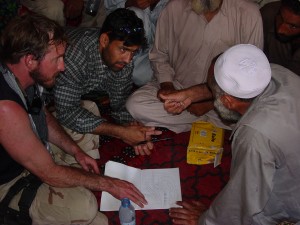
Tribal elders tell US Special Forces about their “muj days,” fighting the Russians
A week ago I ran a post about two young Army captains—Jim Gant and Michael Harrison—who served in the same valley in Konar province, Afghanistan. Their service was six years apart, yet the two were linked by their bonds with a tribal chief named Noorafzhal and by a gift of honor—a shotgun that Capt. Gant and his Special Forces ODA 316 had presented to the tribal elder in August 2003. Just three weeks ago, June 2009, Noorafzhal was still showing that gun off—this time to Capt. Harrison.
This is Counterinsurgency (COIN) at its best and something equally important—positive continuity. The following is from an e-mail Capt. Harrison sent me from Konar a few days ago:
There is definitely a direct carryover of goodwill and overt support for American forces from Maj. Gant and ODA 316. During our first shura (meeting) with the elders in Mangwal [Noorafzhal’s village], we discussed the importance of working together to better their country and village. They all agreed, bringing up their past relationship with “the bearded Americans.”
Tribesmen connect man-to-man. In Mangwal in 2003, Capt. Gant and his team loved to stay up till all hours with Noorafzhal–to whom they gave the honorific nickname, Sitting Bull–listening to his stories of how he and the other tribesmen fought the Russians in the 80s. (Note, in the photo, the sketch of the topography of an ambush.)
I feel [Capt. Harrison’s e-mail continues] that the way Maj. Gant and the rest of his unit dealt with Noorafzhal helped us establish ourselves and cut down on the time required to develop the trust and relationships that yield cooperation, accurate and timely intel and buy-in from the village elders.
This sounds like a success story and it is. But the point to take note of is how accidental it all was. Capt. Gant didn’t know Capt. Harrison. There was no planned or institutionalized contact between the two officers, no handover, no collaboration. A number of other units served in the valley between their deployments. It was just luck that two such tribally-savvy officers happened to work, in different eras, with the same elders and the same tribesmen.
“Sitting Bull” still carries enormous influence [reports Capt. Harrison]. Whenever he arrives at a shura, everyone shuts up and stands up. He is the first to speak on all issues. He “allows” the sub-governor [a non-tribal post of the Afghan government] to assert his power and is careful not to circumvent or marginalize the district leadership. But it is apparent that the respect and power is still there. He could definitely put armed men into the field if he wanted to.
Donald Vandergriff, a retired Army officer and military leadership maverick, asks:
What would have happened if Capt. Harrison and his unit had overlapped with Maj. Gant and his team? It would have made the good situation that Capt. Harrison describes even better. In today’s personnel system, people are seen as individual replacement parts. The system does not take into account the intangibles of unit cohesion, trust and competence. The only way we can successfully wage this war is through the building of professionalism and trust.
To that, I would add the building of ongoing and uninterrupted bonds with village and tribal leaders.
In his book The Sling and The Stone, Col. T.X. Hammes makes a related point:
The weakness of our current personnel system is that it is a hundred years old and grooms people to run organizations based on concepts from another century. Unfortunately, that is not the only weakness. The bureaucratic model itself is a major problem. In this model, “career development” requires frequent moves and a wide variety of duties. The idea is to ensure that every person has the broad range of skills necessary to function at the top of the organization. It focuses on creating generalists rather than experts … [The typical officer’s career pattern] consists of a series of short (one to three years) postings in a wide variety of jobs … They are, in effect, amateurs by profession. They never spend enough time in any one job to become an expert.
How many critical Afghan-to-American relationships are we destroying by failing to rotate or redeploy outstanding officers back into Areas of Operation (AOs) where they have successfully bonded with tribal leaders and elders? Officers like Jim Gant and Michael Harrison should be working together. Their tours should be overlapping or tag-teamed so that tribal leaders don’t have to reconnect with new faces each time around, but can deepen and broaden already-established bonds with men and warriors they know and trust.
I’m certain that addressing this situation is on Gen. McChrystal’s to-do list. I applaud it. And one further thought.
Maybe the clean-shaven look is overrated.
DO THE WORK
Steve shows you the predictable Resistance points that every writer hits in a work-in-progress and then shows you how to deal with each one of these sticking points. This book shows you how to keep going with your work.


THE AUTHENTIC SWING
A short book about the writing of a first novel: for Steve, The Legend of Bagger Vance. Having failed with three earlier attempts at novels, here's how Steve finally succeeded.

NOBODY WANTS TO READ YOUR SH*T
Steve shares his "lessons learned" from the trenches of the five different writing careers—advertising, screenwriting, fiction, nonfiction, and self-help. This is tradecraft. An MFA in Writing in 197 pages.

TURNING PRO
Amateurs have amateur habits. Pros have pro habits. When we turn pro, we give up the comfortable life but we find our power. Steve answers the question, "How do we overcome Resistance?"

Steven,
Glad to see you’re doing some blogging. Hope it don’t take away too much time from your other writing, but I really do like what you’re doing here. My war, (Vietnam) is long over, but I share your fascination for what’s going on in Afghanistan.
I didn’t know you were a Marine. Hats off to the Corps. Some fine Marines kept this old intelligence guy alive a long time ago and I’ll always have a sweet spot in my heart for those great guys. Funny how the tribes have remained much the same since ancient times and as you show, they’re still the key to working over there.
Like a lot of vets, I’m not crazy for us to go to war, but see operations like you’re writing about here are our only hope for success over there.
Keep it up. I was first introduced to blogging when I did some work for now Senator Jim Webb in 2006. I knew Jim only through the emails we wrote back and forth before he got into politics and I’m proud that he’s in the Senate and actually trying to do some good things for our veterans. Jim’s another fine example of a good Marine who continues to give good service to the country. Just my opinion, of course. I don’t know your politics, but I’m of the mind I can be strong on defense and still be a good Democrat. Keep up the good work. You’re one of our national treasures. I hope to be able to real at least a hundred more new titles from you.
Semper fi
Nick
Actually, there is an overlap and handoff from one unit to the next, but it tends to get disrupted by the intersection of military bureaucracy and logistics. For example, then-Captain Gant’s team and that whole rotation from the 3rd SFG(A) were a bit late in coming due to the rotation being scheduled in spring of ’03 — right when Iraq kicked off.
The USA hasn’t really got enough airlift to support even one conflict that far away at one time, so the rotation plan went down the tubes as everybody scrambled for too few seats and cubic feet on too few airframes.
Instead of having a proper handoff, the outgoing elements of 20th SFG(A) and 7th SFG(A) were directed to write as much as they could up, and hand it off on a CD or DVD at the grip-n-grin with their relief element. This was directed by the planners somewhere, probably CENTCOM or CENTSOC. In their defense, they were reacting to (1) a sudden loss of airlift and (2) an absolutely inflexible schedule for demobilizing the National Guard 20th (if they went “overtime” it would cost the USG many millions more because of artifacts in the laws relating to reserve forces mobilization).
This is one example, but this kind of thing happens all the time. For instance, at tour’s end a handful of soldiers always try to volunteer for a back-to-back tour, but there’s no system in place to give them that (and provide the incoming unit with that vital continuity that prevents the Vietnam “one year ten times” experience). This is an unintended consequence of the generally highly beneficial system of unit, instead of individual, replacement. But there is no way to address or fix these unintended consequences — a blind personnel system must have its pound of flesh.
There is a soldier turned scholar, “Gunner” Kalev, that terms this kind of folly “Persistence of Peacetime Personnel Procedures.” He’s also an SF veteran, at the NPGS and worth looking up.
I hate to monopolize your comments , but I made an error — two actually — in my first post. Kalev is the Gunner’s first name (he was an artillery officer before going SF — like Afghanistan, the Army is a tribal society). Kalev I. Sepp is his proper name. NPGS is my acronym for the Naval Post Graduate School but the Navy uses a single word for Postgraduate. My apologies to all our web-footed friends, and to anyone who could not find Dr Sepp’s CV based on my initial BOGINT.
I must add — I don’t know without checking that A-316 actually relieved a 7th or 20th element. (In Konar, it would have been 20th, probably). Some of the incoming teams went into all-new areas, and some areas that had been covered by teams on the previous rotation weren’t seen as needing a replacement (i.e. they were functioning well and had low insurgent activity). Some of those empty places have been filled in again (nature of war includes change — not that I need to tell the guy who wrote Gates of Fire that).
So, it’s quite possible that Captain Gant and his men went in “cold-calling” someplace new (in which case no handoff was possible). It’s also possible, even likely, that there hasn’t been any American with Noorafzal continuously over the last six years. To actually do this stuff is harder than it looks.
Great post. You know one thing that can help in the ‘hand off’ is to have a running online database that is secure and accessible by incoming and outgoing units. Or better yet, a social networking site. If lets say each contact with a village elder or chief gets it’s own group page(facebook style), and various units continue to add blog posts about what they talked about in regards to that group, then you could have a running archive of all of the work. And let’s say these SF troopers had profile pages that would show up in their discussions about that village, that others could access and communicate with at anytime, then that would help out the learning organization as well. It would be kind of like TIGR, but it would be a social networking site to track the work done in all of the villages. The best part is you could add video, you could search the archives of discussions, you could search any attacks on the villages, etc., all based on what was added to the network by the participants.
As for access to the internet in the middle of nowhere, we have that capability as well. To me, a site like this would be very helpful to maintain continuity between the various transitioning groups that are doing work with these villages. Now if they already have something like this, I will shut up. lol S/F
I am delighted that you have this blog and I will be a regular visitor.
I was an infantry LT in the late Vietnam era, after law school ROTC at Georgetown. I was a reserve officer and never saw a shot fired in anger, but trained for the job and was one of the top officers in my IOBC class. An accomplishment I still put up there with being National Moot Court Champion in law school.
I studied political science and history before law school and got back to military history and tactics during and after IOBC. It remains my hobby, including war gaming.
I am struck by how much we forgot from the Vietnam era on our counter-insurgency tactics. We started both Vietnam and Operation Iraqi Freedom dedicated to firepower per se. We learned in Vietnam that the fire base strategy would not work and that by not occupying hamlets and bolstering local capabilities, we simply had to keep “re-taking” the same hamlets. General Petraeus seems to have been the first theater commander to understand this. Maybe it is no coincidence since he is one of the chief counter-insurgency experts in uniform.
This naturally evolves into working within the framework of local leadership, whatever it is. We will not change it in the short period of a campaign and will always need to adapt to it to make “holding ground” a sustainable operation.
The Sunni “Awakening” was the key to success in Iraq. It got Sunni tribal leaders to start active cooperation with US forces. We armed them and provided direct “tribal support” in civic works. We worked through the tribes. This was almost wildly successful in turning around the Iraqi War in ways that your video clip from 2006 shows were then believed impossible by most (not this writer at the time). While the Sunni/Shia split may be irrelevant in Afghanistan, the role of tribal, local government is not. Where the national government is weak or almost non-existent (Afghanistan), the role of tribal leaders will be proportionally more significant IMO.
I will not slug through your “tribal” videos and hope that I am not being redundant in my comments.
Randy Mott
ex-pat in Warsaw, Poland
Great beginnings to a promising blog. Kudos to you, Sir.
Now to the “defeatism” : how is it possible to do the kind of COIN that was so successful in Iraq when the White House has made it clear to the theater commanders that there will be NO, I repeat, NO consideration whatsoever of any, additional reinforcements. 68,000 troops is it. End of story. Is there anyone out there with any credibility that believes that even the U.S. military, as adaptive and innovative as it has proven to be in Iraq, can effectively blunt the insurgency in A-stan with a piddling 68,000 force? Recommend The Captain’s Journal blog.
God, I hope I am wrong but I predict that we will see in the next 6 months: a) COIN by FOB — which is what we have now, largely– and this will get us nowhere towards victory, or; (b) shocking casualties as aggressive commanders try to push out into the local populace as in Iraq but, with only 68,000 total force, there will be nowhere near enough rapid reaction forces and several units will be overrun and wiped out which will lead the POTUS to order option (a) above, or; (c) COIN by whack-a-mole where large operations are launched and insurgents are cleared out and killed only to have them pop up elsewhere or return as soon as the operation is over due to a lack of troops to leave in place to hold cleared territory.
Sadly, brave troops and marines are going to die because our political leadership is not committed to victory but just the veneer of an effort that will lead to the inevitable “quagmire” and withdrawal in disgrace. Remember, the MSM is now an organ of the White House, so when their coverage of A-stan goes negative, it will be due to a signal from the WH that it is time to pull the plug on the effort, consequences and reality be damned.
I have never served in the military, much to my regret in my twilight years, although both my brothers served in the South African Army during the Angola affair and one was killed there, so I have some empathy for the way the armed services work. Since retirement I have been drawn to study military systems as a prototype for civilian business practice. This is not the first time this has been done. Jack Welch at GE, for instance, valued the input of military officers in his management seminars (see his autobiography). My chosen field is engineering, and failure prevention in particular. This is what led me to examine management systems because, contrary to popular opinion, things don’t break because the engineers fell down on the design, or because the operators were dumb, but because the system they were constrained to work in prevented them from doing the right thing! For confirmation just read the accounts of the two space shuttle disasters. Good, competent and dedicated people, who knew there was something wrong, were forcibly restrained from expressing views which ran counter to the prevailing doctrine. Do any of you veterans recognize anything here? My question is, given these same pressures, how does the military, generally speaking, succeed so well on the ground? Engineers seem to be unable to emulate, specifically, combat troops, in the latters’ ability to get the right thing done against the gradient set by people in galaxies far away. Fragging your boss is a great temptation, but probably not an option, no matter how attractive. Seriously, I welcome ideas on how competent civilian, mainly engineering work can be done, if necessary against the tide of managerial disapproval, by mimicking the military way.
Congratulations on your blog, Steven. Instapundit has you linked, so gird yourself for an “Instalanche” of visits.
I greatly enjoyed “Gates of Fire”.
Glad to learn of this blog; I’ve enjoyed your books. Also glad you’re a former Marine. Re learning/re-learning old lessons: The military politicians who get to the top of the defense establishment (to me, Colin Powell is a prime example) are all Big Picture Guys, Strategic Thinkers, able to marshall vast hoards of troops, equipment, and logistics over vast fields of endeavor. That’s fine for the Fulda Gap, even the sands of Iraq maybe but not for this tribal stuff. And the tribal stuff is probably where we’re going to be fighting for the next military generation. The writings of Chesty Puller about Haiti, the Combined Action Platoons in SVN–all forgotten until the next time.
But here’s some hope: think of all the young Lts-Majors, Corporals-SSgts who are being raised up in this current environment. Some of them will become generals and SgtMajs and maybe then things will perk up. Also, Petraeus may have enough clout to drag certain like-minded people along with him.
Hello Steve, this is a great idea! It never sises to remind me of how little we learned from our past mistakes. I was in the Air Force during our Vietnam War. Politics and the will to win will always butt heads in the US. Some politicians couldn’t wait to see us lose in Iraq and Vietnam. Along with changing our way of thinking on the battlefield, we need to do the same in Washington.
You have me hooked. Keep up the good work.
Regards
Wolf
Steven,
Great stuff. My experience was as a Marine platoon commander in Somalia and our CO worked against the tactical thinking by cleaning up streets, scrounging lumber from the UN compound to give away to our AO, etc. It paid enormous dividends.
Hadn’t thought about the personnel/career path problem in this light but also see the benefits of longevity. Transfers to the business world, too, and I’ll now keep that better in mind with my people (www.S3.com).
Thanks, I’ll keep reading. Jack
I don’t know the two gentlemen in question but it is likely that if they are exceptional in the above role they were exceptional in what they did before that. Fortunately a keen personnel manager did not lock them into logistics when they were outstanding XOs and S4s, or into training when they excelled as cadre or OCs. The system benefits from fortuitous accidents, and the equally likely mistakes are inevitably rectified.
Yes. The current system is frustrating. The critique of the personnel system creating generalists rather than experts is true. The advantages of enhanced continuity are obvious.
But… you cannot optimize for everything. I doubt it was by design but the current system does avoid the long term institutional sclerosis, empire building and turf wars that plague organizations where roles and responsibilities are endlessly refined and narrowed. The current system does create adaptable leaders—ones who won’t be obsessed with re-fighting the last war—at the cost of waste and friction. All systems, human or mechanical, require its designers to trade various efficiencies. I think our system today is pretty close to right. There is probably room for more commander flexibility in a time of war. Technology, properly applied (today it is not) can definitely ameliorate the worst outcomes. Those are improvements around the edges. I would love to hear of an alternative that does not require its implementors (the actual personnel decision makers) to possess above average capabilities.
No, I do not think the system achieves optimal results, but I think it may avoid the worst.
Mr. Pressfield,
I’m an Army Chaplain in an SF unit. Heading to Afghanistan in the future (won’t say when), so I’m glad to keep up with your site as mission preparation. Have read Killing Rommel (and recommended it to many) and Gates of Fire. Heard you on Hugh Hewitt as well–which lead me to Killing Rommel. Thanks for your work.
Chaplain Lowthian
Really enjoyed your videos, very graphic but accurate portrayals of a war that can’t be won. The Soviets sent in their army and Spetsnaz special forces, fought the Taliban for 10 years, and still couldn’t beat the Taliban. Of course, our CIA was kind enough to train and equip this army of fanatics who now are fighting US. Who exactly at the CIA was in charge of this fiasco?
Now, we are asking the US Marines to drive the Taliban out. But, strangely, Obama has asked these Jarheads not to fire in civilian areas. Wow, if I was a Taliban leader, I sure would want to hide out and place my mortars, snipers, and rocket launchers in a civilian village. And, the Marines are in the valleys and the enemy has the high ground. Gosh, another cluster f..k!
I spent 20 years as an officer in Naval Intelligence, two tours in Viet Nam in combat gathering tactical intel, mission planning, and catching and interrogating Congs and NVA soldiers. Afganistan will be another Nam as Obama and his merry men are clueless when it comes to fighting a war. The enemy will wait us out since Muslims, while terrible regular soliders, make great guerilla fighters and have lots of patience. After we leave Iraq, Iran will invite itself in to maintain security and the UN won’t say squat.
Nice, but nothing new. The best work in Afghanistan was done early by properly trained and educated Special Operations Forces (beards and all). In both Iraq and Afghanistan, we send troops trained to break things–a necessary skill in winning conventional wars–into COIN situations and tell them to figure it out of the ground. Want to win in Afghanistan? Put US SOF in charge of operations with coalition SOF and conventional troops in support. They should work hand-in-glove with CIA, Dept of State, USAID and, most importantly, the Afghan government under a clear strategy (and authority) from the President. Sounds simple, but we continue to get it wrong.
I spent 3 years in Saudi Arabia in the late 70’s as the Kingdom was making the surface shift to the modern world. More than half of Ryadh was still made of mud. Jedda was as if in a time machine.
My Bible was Lawrence and Bell. I spoke no Arabic, but worked hard on the lessons of this being a formal society where men spoke to men.
For my first year, I would show up at the mazlis of the big men and just sit and drink coffee. Because I showed up often and behaved (kept my mouth shut until spoken to) after a while, I would be asked questions. Usually about things that I had no knowledge of. I was being tested for being a caring person. Over time, I would move up the side of the group and get closer to the man. More often I would be asked my opinion. I knew I was “In” when the Coffee men would give me a smile of recognition.
I had a great boss – an English aristocrat – who understood all of this implicitly – his core advice was to listen for the “Test”. He told me that at some point I would be given a hint of a desire – not for a bribe but to tell me about something that meant a lot to the “man”. The unaware or the inattentive would miss it – it would be subtle.
It was the next summer, Wimbledon was in full swing. My client and I were chatting about tennis. He had been educated in England and sounded more English than I did. Then it came. He said how sad he was that it was so hard to get tickets for centre court. It was just a passing thought in a long conversation and was not spoken as a question or a request.
I sense that this was it, the test, but had no idea of what to do. So I asked Chris. He laughed and went over to the trading desk – “Rob” he said “Centre Court Tickets are traded on the LSE” I go back onto the line with Hisham and told him that he could buy a pair of tickets for this price – he said yes immediately.
This was my “shotgun” moment. It was not even a “gift” – it was an act of paying attention. Of showing that I cared.
As a consequence, I too was adopted, I was in my late 20’s by one of the leading Jedda families, the Alireza’s and this tribal connection became my safety net and my entree.
Consequently I had a very different experience in the Kingdom than most of my competitors. Not only did I build a great business there, but I felt as if I was going home whenever I arrived there. I lived in the local world rather than the bubble. The irony would be when I took down senior partners of my firm to the country. All the attention would be paid to me – after all who were these men whom they did not know.
I miss it very much.
I think that your idea of senior officers staying out in Afghanistan for maybe 10 -15 years is essential. You surely have to know and love the country that you are tasked to work in. Not just at the senior level as I found out. Would it be impossible for a young American man to make his career the connector? It took me less than 2 years to gain the trust and I did not speak Arabic. 3-5 years as a Captain or WO spread all over the country would anchor the mission – there would always be a hand over and a legacy.
Thank you Mr Pressfield – for all your books and insight and for this forum